
Introduction of Exir Halal Asaluyeh Petrochemical
The petrochemical complex was established in 1397 (2018) with the aim of producing valuable petrochemical products and, following the completion of construction and equipment installation, became operational in 1400 (2021). Utilizing advanced technologies in compliance with international standards, the complex currently produces Normal Pentane, Iso-Pentane, and Hexane. The feedstock for this petrochemical plant is supplied from raffinate produced by Nouri Petrochemical Company.
Analysis of Normal Pentane from Exir Halal Asaluyeh Petrochemical
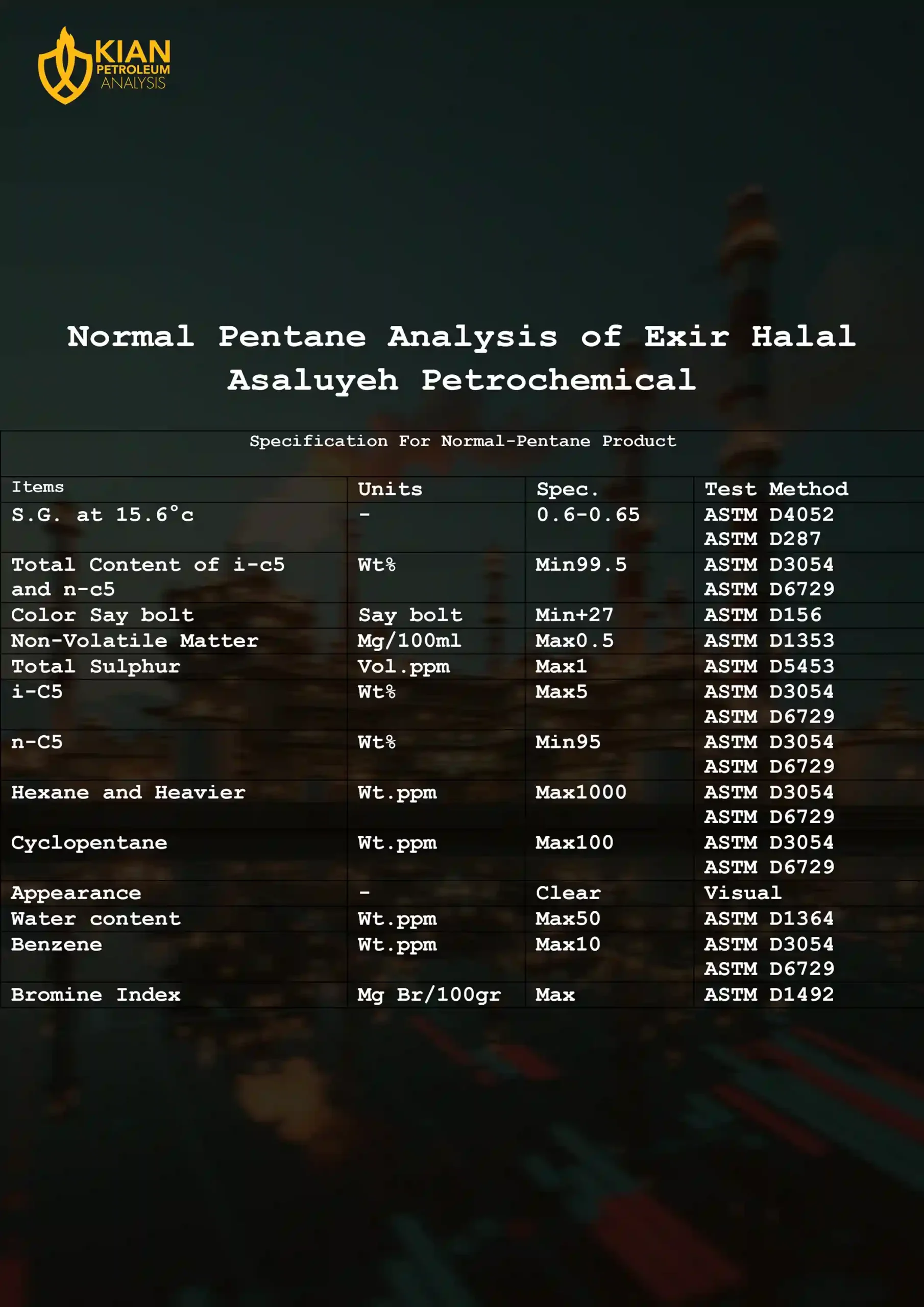
SG at 15.6°C
S.G. stands for Specific Gravity, representing the relative density. In this parameter, the density of Normal Pentane is compared to pure water, and according to the analysis sheet, its value ranges from 0.60 to 0.65. In other words, this indicates that Normal Pentane from Exir Halal Asaluyeh Petrochemical has approximately 60 to 65 percent of the density of water at 15.6°C, demonstrating the product’s high purity and suitability for industrial applications.
Normal Pentane and Iso-Pentane
According to the Normal Pentane analysis from Exir Halal Asaluyeh Petrochemical, the total of Iso-Pentane and Normal Pentane constitutes at least 99.5 wt% of the product composition. Of this total, Normal Pentane accounts for a minimum of 95%, while Iso-Pentane accounts for a maximum of 5%. This demonstrates the high purity and quality of this product.
Cyclopentane
Cyclopentane is a cycloalkane (a cyclic hydrocarbon) considered as an impurity in Normal Pentane, typically originating from naphtha refining processes, crude oil distillation, and unintended reactions such as thermal or catalytic isomerization. Additionally, excessive presence of Cyclopentane in Normal Pentane can influence key properties such as boiling point, vapor pressure, and viscosity, thus causing problems in precise industrial and chemical applications, such as polymer production or solvent usage. Therefore, strict control of this compound is crucial in petrochemical products.
Hexane and Heavier Compounds
Hexane and heavier compounds are recognized as impurities in Normal Pentane, and according to the analysis provided by Exir Halal Asaluyeh Petrochemical, their allowable levels must be controlled and limited to a maximum of 1000 ppm (parts per million by weight). Higher concentrations of these impurities can significantly reduce the volatility of the product, leading to sedimentation or thermal instability, making it unsuitable for industrial applications such as gasoline octane adjustment or plastics manufacturing. Hence, controlling the levels of impurities such as hexane is critically important.
Color say bolt
The Saybolt color scale is a recognized and standardized method for assessing the color and transparency of refined liquids, such as fuels, gasoline, jet fuel, diesel, and refined products. This scale ranges from +30 (completely clear or colorless) to -16 (dark yellow). A higher positive number indicates greater clarity and purity. According to the provided specifications, a minimum value of +27 means the product must be very clear, nearly colorless, and free of contamination from impurities or oxidation.
Non-Volatile Matter
Non-volatile matter refers to impurities that remain as residues after evaporation, typically originating from incomplete refining processes, environmental contamination, or inadequate separation of heavier fractions during distillation. Excessive amounts of non-volatile matter can adversely affect product quality, causing deposits, instability, or reduced performance in applications. According to the analysis sheet, controlling the non-volatile content in the product is crucial to maintain product purity and optimal functionality.