
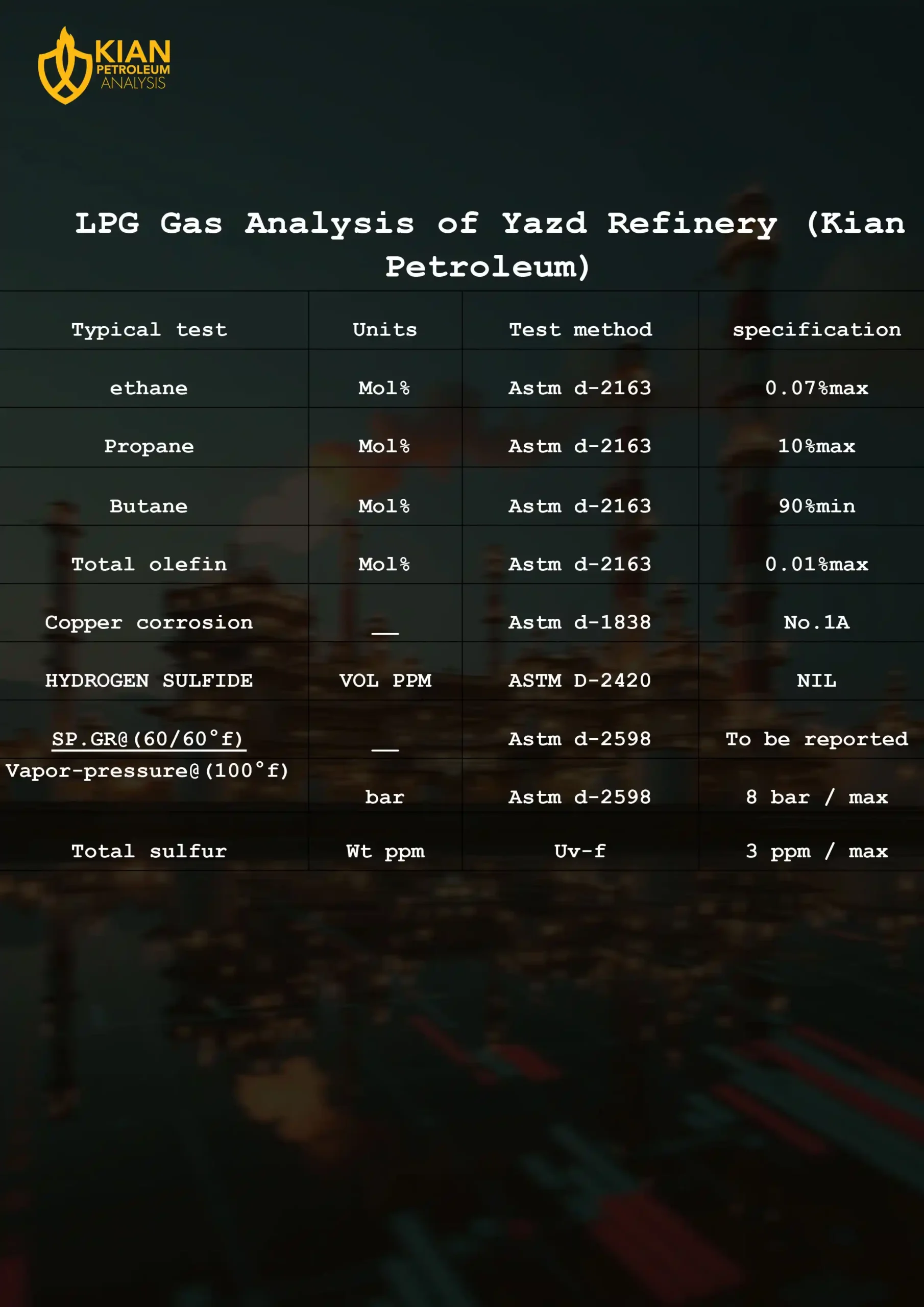
Yazd Refinery, owned by the private sector, is one of the most reputable refineries in the country, specializing in the production of gas products and derivatives such as isobutane, butane, pentane, and LPG. Kian Petroleum Company, as the exclusive representative of this refinery, provides specialized services for the direct supply and transportation of these products with the highest quality. We will elaborate on this topic further and ultimately analyze the LPG gas composition from Yazd Refinery.
Features of Yazd Refinery
Private Ownership
Yazd Refinery is privately owned, which has provided it with significant advantages. This ownership structure has enabled the refinery to avoid the common limitations and challenges faced by state-owned refineries, including international sanctions and the complexities of administrative bureaucracy. As a result, the refinery has been able to expand its operations directly and without the usual obstacles in domestic and international markets.
Flexibility in Purchase Quantities
Due to its private ownership, Yazd Refinery does not offer its products through the stock exchange, which has freed it from restrictions such as minimum purchase quantities. In the stock market, buyers are typically not allowed to purchase less than a specified amount, but at Yazd Refinery, customers can easily procure any desired quantity, from the smallest amount to larger volumes, as needed.
Diverse and High-Quality Products
Yazd Refinery, by producing products such as isobutane, normal butane, pentane, and LPG, plays a significant role in meeting domestic needs and exporting to regional markets. These products, manufactured with high-quality standards and using the latest technologies, are exported to neighboring countries such as Turkey, Pakistan, Afghanistan, and other export destinations.
Kian Petroleum Services
Kian Petroleum Company is a specialized and leading company in the gas sector that directly and without intermediaries supplies the gas products needed by customers from Yazd Refinery. Additionally, Kian Petroleum, utilizing its dedicated and standardized transportation fleet, provides transportation services for these products to neighboring countries such as Turkey, Pakistan, and Afghanistan. Furthermore, the company facilitates customs procedures at borders and streamlines the processes related to the clearance of goods, making the purchase and transportation process easier for its customers.
Analysis of LPG Gas Parameters
Propane and Butane
In the analysis of LPG gas from Yazd Refinery, the higher percentage of butane compared to propane indicates that the LPG is of the “warm” type. Due to the higher butane content, this composition has different properties compared to propane-dominant LPG. Butane has a higher boiling point than propane, making this type of LPG easier to store and transport in moderate or warm environmental temperatures.
Warm LPG is suitable for applications where rapid evaporation at low temperatures is not required. This gas is commonly used for cooking, household heating in tropical and temperate areas, and as feedstock in the petrochemical industry. Due to the higher density and lower vapor pressure of butane, this type of LPG has the advantage of easier storage and transportation under normal temperatures, although its evaporation performance may be limited in cold environments.
Ethane
Ethane is a light component that can affect the quality, safety, and performance of LPG. Due to its very low boiling point and high vapor pressure, ethane can increase the pressure in storage and transportation tanks, potentially leading to risks such as leakage or explosion. Therefore, the ethane content should not exceed standard limits. Additionally, LPG with lower ethane content performs better in applications requiring stable and specific vapor pressure, such as domestic and industrial fuel or petrochemical feedstock. This feature reflects higher quality LPG for consumers.
Olefins
The presence of olefins in LPG refers to unsaturated hydrocarbon compounds with double bonds, such as propylene and butylene, which are typically produced during refinery processes. Olefins can enhance the calorific value and flammability of the gas but may also cause issues. These issues include a tendency to form polymeric deposits that can clog equipment, corrosive properties in the presence of moisture or reactive substances, and a decline in quality during long-term storage. Therefore, controlling the amount of olefins in LPG is of significant importance.
Copper Corrosion
Copper corrosion refers to the process of surface degradation of copper caused by contact with corrosive agents such as sulfur compounds (e.g., hydrogen sulfide or mercaptans), moisture, or other chemicals. This phenomenon is particularly critical in the oil and gas industries, as the presence of corrosive substances can damage metallic equipment like pipelines and storage tanks. The Copper Corrosion Test is conducted to evaluate the quality of gases and determine whether the gas contains corrosive substances that might harm the equipment. The results of this test, usually reported as discoloration or the extent of corrosion, provide information about the gas’s purity, safety, and compatibility with equipment. Gases that do not cause copper corrosion are safer and more suitable for use in sensitive industries.
Hydrogen Sulfide
In the analysis of LPG gas from Yazd Refinery, the hydrogen sulfide (H₂S) content is reported as “nil,” indicating that the LPG is completely free of hydrogen sulfide. The absence of H₂S is a significant advantage, as this gas is highly toxic and corrosive. At high concentrations, hydrogen sulfide can damage the human respiratory system and, with prolonged exposure, may even be fatal. Moreover, the corrosive nature of H₂S can harm metallic equipment, such as storage tanks and pipelines, leading to rapid corrosion. Therefore, the absence of this substance in LPG ensures greater safety for users and enhances the durability of storage and transportation equipment.
Conclusion
In conclusion, Yazd Refinery, with its private ownership and high-quality production of products such as LPG, isobutane, and pentane, has achieved a prominent position in meeting domestic needs and exporting to regional countries. Its collaboration with Kian Petroleum as the exclusive representative has streamlined the processes of supply, transportation, and customs clearance for customers, making them more efficient and straightforward. The analysis of LPG from Yazd Refinery highlights adherence to high-quality and safety standards, including the absence of hydrogen sulfide and the control of harmful components such as olefins and ethane, ensuring the safety, efficiency, and quality of the products for various applications. For more information on how to purchase, our experts are ready to assist customers.