
Introduction to the National Iranian Oil Refining and Distribution Company(NIORDC)
The National Iranian Oil Refining and Distribution Company (NIORDC) is one of the four main subsidiaries of the Ministry of Petroleum of Iran. It was established in 1991 and officially began its operations in 1992. This company was created based on the principle of separating the upstream activities of the Ministry of Petroleum from its downstream operations.
In general, activities in the oil and gas industry are divided into two main sectors: upstream and downstream. Upstream activities include the exploration and production of crude oil and gas, while downstream activities involve the production of petroleum and gas products, as well as their transportation, distribution, and export.
Before the establishment of NIORDC, these activities were carried out separately by various companies. However, with the formation of this company, operations were organized, and each subsidiary was assigned specific responsibilities, all operating under the supervision of the National Iranian Oil Refining and Distribution Company.
The National Iranian Oil Refining and Distribution Company (NIORDC) has five subsidiary companies:
• National Iranian Oil Products Distribution Company
• Oil Refining Companies
• National Iranian Oil Engineering and Construction Company
• Oil Refining Industries Development Company
• Oil Pipelines and Telecommunications Company
Additionally, this company supervises the operations of the Abadan, Bandar Abbas, Tehran, Isfahan, Shiraz, Arak, Kermanshah, Tabriz, and Lavan oil refineries.
In the following, we will analyze the LPG composition of the refineries under the supervision of the National Iranian Oil Refining and Distribution Company.
Analysis of LPG Composition in the National Iranian Oil Refining and Distribution Company
Propane and Butane
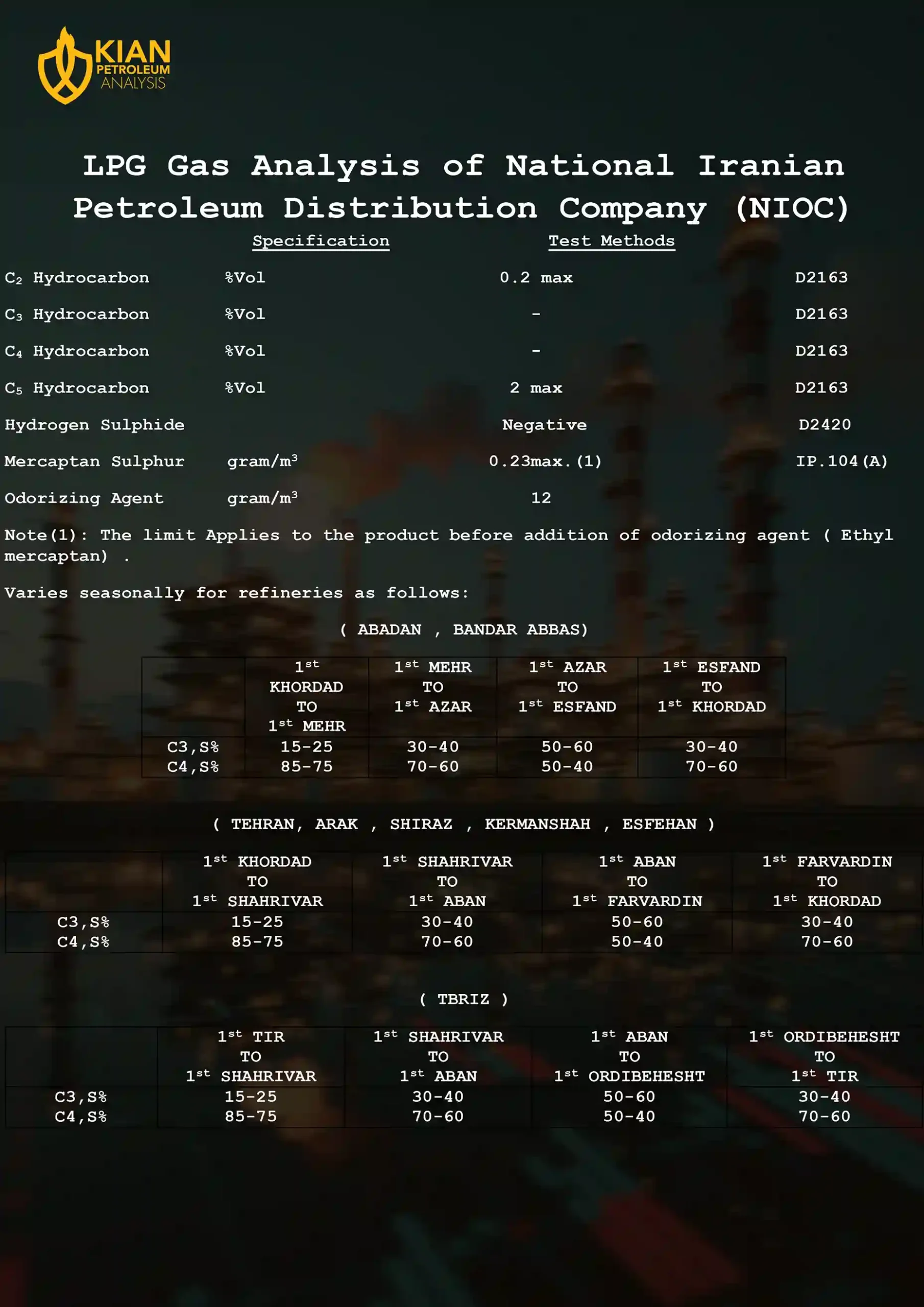
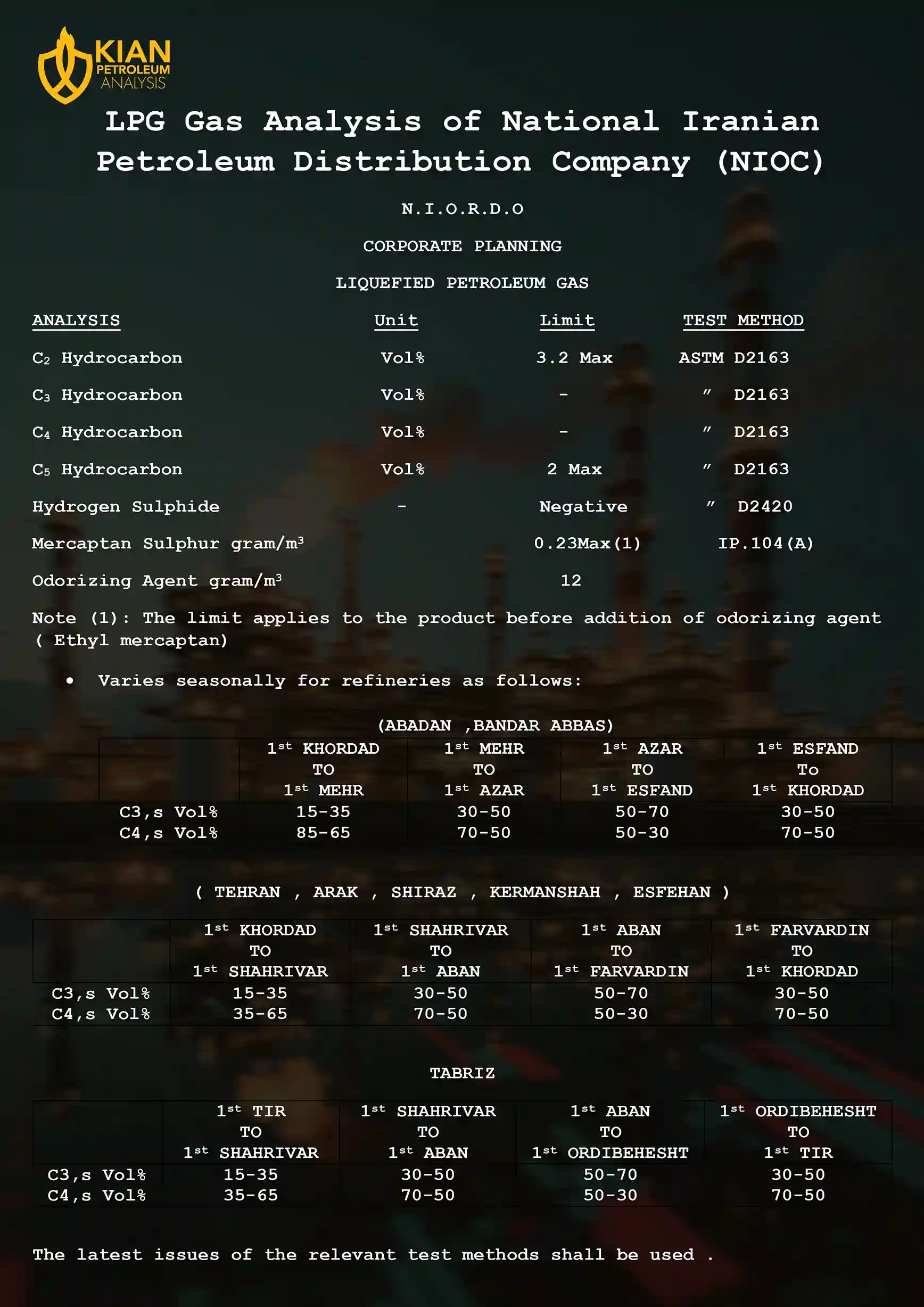
As observed in the three tables at the bottom of the LPG analysis sheet from the National Iranian Oil Refining and Distribution Company, refineries adjust the composition of their LPG according to different seasons of the year.
LPG supplied during the colder months contains a higher percentage of propane compared to butane. This is because propane, due to its lower boiling point, performs better in cold weather. On the other hand, LPG supplied during the warmer months has a higher butane content than propane, as butane performs better at higher temperatures.
For example, in the last table of the analysis sheet, the composition of LPG from the Tabriz refinery is shown to vary throughout the year. During the period from early Tir (June 22) to early Shahrivar (August 23), when temperatures are higher, the propane percentage ranges between 15% and 35%, while the butane percentage varies between 65% and 85%. Therefore, the LPG supplied during this period contains a higher proportion of butane.
C2 (Ethane)
A small and controlled amount of ethane is present in the LPG analysis of the National Iranian Oil Refining and Distribution Company, which indicates the high quality of this product. Since ethane is a light hydrocarbon, it can easily evaporate and pose safety hazards.
C5 (Pentane)
Pentane is a five-carbon hydrocarbon, and its excessive presence can lead to incomplete combustion of LPG fuel. Additionally, this hydrocarbon can deposit in various equipment, gradually reducing their efficiency over time.
Hydrogen Sulfide
According to the LPG analysis of the National Iranian Oil Refining and Distribution Company, the supplied LPG is free of hydrogen sulfide. Hydrogen sulfide is a corrosive and hazardous compound that can damage equipment and also pose health risks to humans.
Mercaptan
Liquefied Petroleum Gas (LPG) is a colorless and odorless gas, making leak detection difficult. Therefore, a small amount of mercaptan is added to the gas. This compound produces a strong and distinctive odor, allowing for quick identification in case of a leak.
Final Remarks
The National Iranian Oil Refining and Distribution Company, as one of the subsidiaries of the Ministry of Petroleum, supervises nine refineries across the country. In this article, we have analyzed the LPG composition produced by these refineries. As observed, these refineries produce high-quality liquefied petroleum gas (LPG) that complies with both national and international standards.
For more information on how to purchase LPG, you can visit the relevant page on buying LPG from the stock exchange.