
تاریخ بروزرسانی(Update Date): 28th July 2026
Introduction to Imam Khomeini (Shazand) Arak Oil Refining Company
Imam Khomeini (Shazand) Arak Oil Refining Company, located 20 kilometers from the city of Arak, is one of the most significant refineries in the country. It is the second-largest gasoline producer in Iran, producing fuel that meets Euro 4 standards. As one of the most advanced refineries in the country, the company is continuously engaged in research and development to achieve its strategic goals.
Among its key initiatives, the company has designed and established RCD and RFCC units, which have led to reduced environmental pollution and improved product quality. These units also enable the conversion of heavy petroleum residues into lighter, higher-value products.
One of the primary products of this refinery is LPG (Liquefied Petroleum Gas), which consists mainly of propane and butane and is widely used as fuel. In the following section, we will examine the LPG analysis of Imam Khomeini (Shazand) Arak Oil Refining Company.
Analysis of LPG Parameters
Sp.Gr (Specific Gravity)
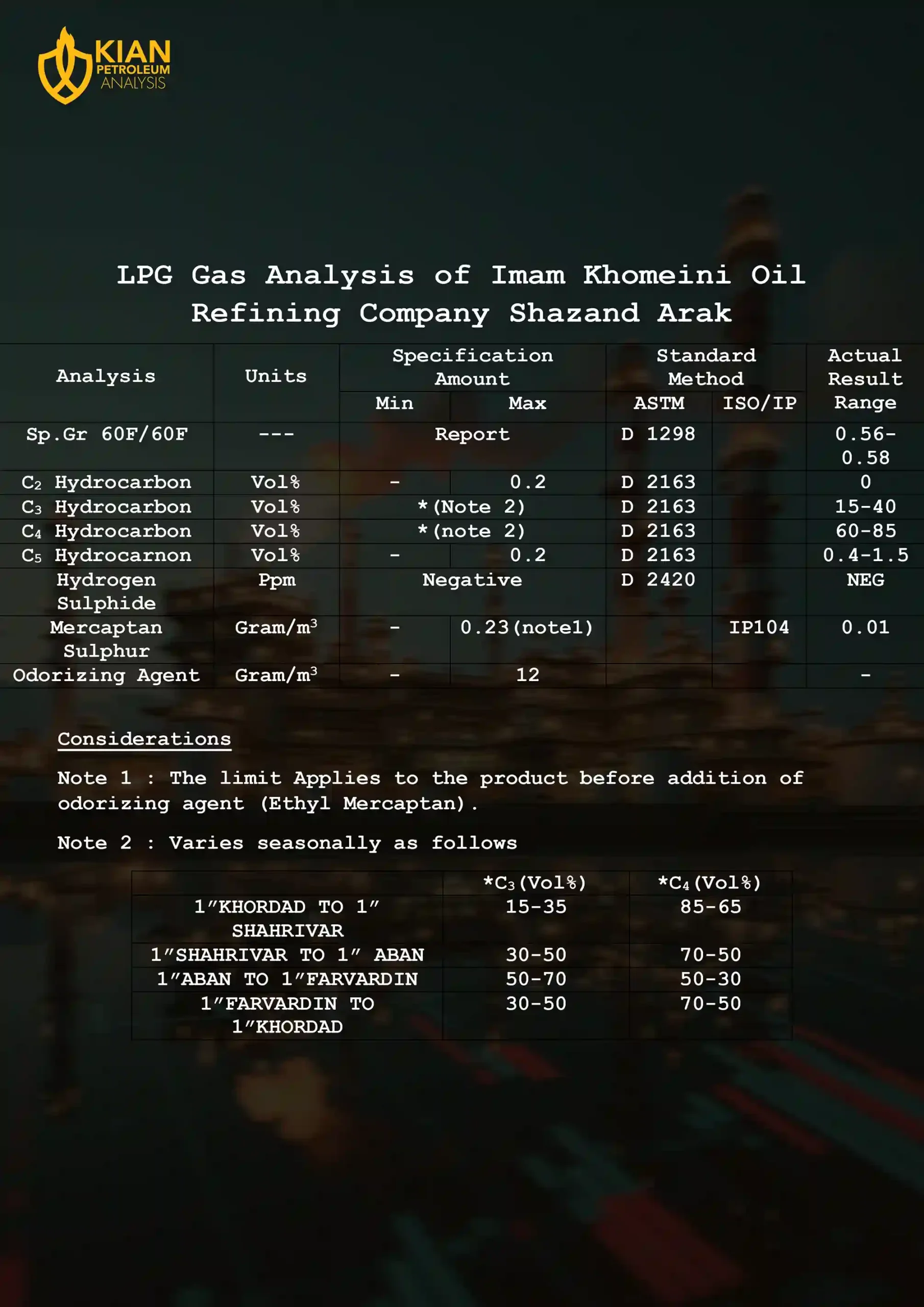
Specific Gravity (SG) is the ratio of the density of a substance to the density of a reference material, which is typically pure water at 60°F (15.56°C). The density of water at this temperature is approximately 1 g/cm³, and the standard SG range for this mixture is set between 0.56 and 0.58.
Deviation from this range can affect key product characteristics; an SG higher than the standard limit may lead to reduced volatility and increased viscosity, negatively impacting industrial processes such as fuel combustion and evaporation. Conversely, an SG lower than the standard range may result in excessive volatility, reduced product stability, and complications in transportation and storage.
Therefore, the producer must ensure that this product is supplied within the standard SG range to maintain optimal quality and performance while preventing operational issues in industrial and commercial applications.
C3 and C4
C3 (Propane) and C4 (Butane) are two key parameters in LPG (Liquefied Petroleum Gas) analysis, where the ratio between them determines whether the gas is classified as warm or cold LPG. To better understand this concept, it is essential to define these two types of LPG:
- Cold LPG refers to a product in which the percentage of propane (C3) is higher than butane (C4). This distinction is based on the different boiling points of these two components. Propane has a lower boiling point than butane, meaning that in cold weather conditions, LPG remains in its gaseous state and remains usable.
- In contrast, if the percentage of butane (C4) is higher than propane (C3) in the mixture, the boiling point of LPG increases. As a result, in lower temperatures, the gas may condense into a liquid state, making it less effective for use. Therefore, the selection of LPG type should be based on climatic conditions and regional temperatures to ensure optimal performance.
According to the LPG analysis report from Imam Khomeini (Shazand) Arak Oil Refining Company, the LPG produced is classified as warm LPG, as the percentage of butane is higher than propane. However, as noted in Note 2 at the bottom of the analysis report, the refinery adjusts its LPG composition based on seasonal variations. For example, from November 1st to March 1st, cold LPG is supplied. This adaptability demonstrates the company’s commitment to meeting seasonal demands and customer needs.
Hydrogen Sulfide
Hydrogen sulfide (H₂S) is a harmful and toxic gas, and the lower its concentration in LPG analysis, the higher the quality of the product. When LPG containing hydrogen sulfide burns, it produces sulfur dioxide (SO₂), which then reacts with water vapor in the air to form sulfuric acid (H₂SO₄). This process can lead to acid rain, which has serious environmental consequences.
Additionally, hydrogen sulfide can cause respiratory problems and pose significant health risks to humans. This toxic compound can also corrode industrial equipment, leading to operational issues and increased maintenance costs. Therefore, H₂S must be removed from LPG to ensure safety and product quality. As observed in the LPG analysis report from Imam Khomeini (Shazand) Arak Oil Refining Company, the concentration of hydrogen sulfide is well-controlled.
Purchasing LPG from Imam Khomeini (Shazand) Arak Oil Refinery
In this article, we introduced Arak Oil Refinery and analyzed the LPG product it offers. For more information on the purchasing process, you can visit the “How to Buy LPG from the Energy Exchange” page. This page provides a comprehensive guide on the procedure for purchasing liquefied petroleum gas (LPG) through the Energy Exchange.