
تاریخ بروزرسانی(Update Date): 18th July 2026
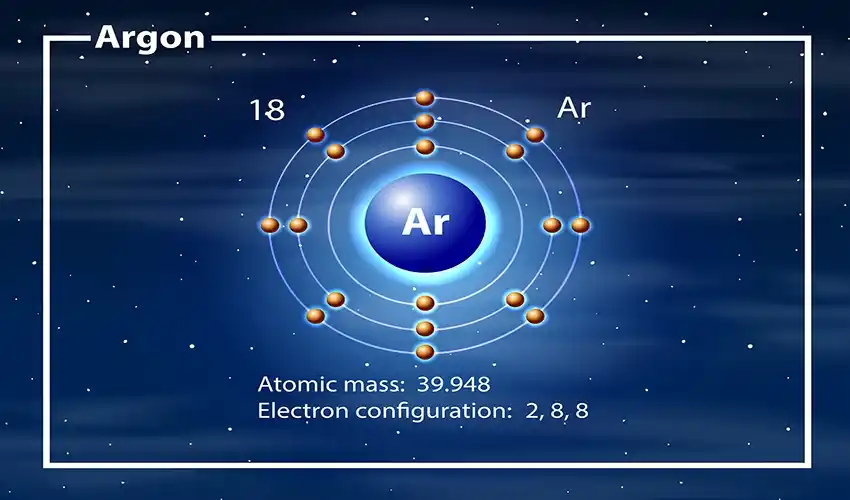
Argon gas (Argon) is a chemical element with the symbol Ar and atomic number 18, belonging to the noble gases group in the periodic table. This colorless, odorless, and tasteless gas makes up about 0.93% of the Earth’s atmosphere and is obtained through the cryogenic separation of liquid air. Similar to helium, argon does not participate in almost any chemical reactions. This gas is used as an inert atmosphere in environments sensitive to chemical reactions and plays a significant role in protecting sensitive materials and ensuring precise control of industrial processes.
Properties of Argon
Properties of Argon |
Odorless, tasteless, and colorless |
Atomic mass: 39.948 |
Boiling point: -185.7°C |
Melting point: -189.3°C |
Density at STP: Approximately 1.784 g/L |
Inertness and lack of participation in chemical reactions under normal conditions |
Methods of Argon Gas Production
The cryogenic separation method is the most common and cost-effective way to produce argon on an industrial scale. Cryogenic separation, or fractional distillation of liquid air, consists of the following steps:
- Air Compression: First, air is compressed using compressors. The air pressure is typically adjusted between 6 to 10 bar.
- Air Purification: The compressed air enters the purification unit to remove its impurities, such as water vapor, carbon dioxide (CO₂), and solid particles. This step is critical because these impurities can freeze at low temperatures and disrupt the process.
- Production of Liquid Air: The purified air passes through heat exchangers and enters an expansion system. In this system, pressure and temperature are significantly reduced, causing the air to liquefy.
- Primary Distillation: The liquid air enters the main distillation column. In the main column, the temperature is gradually increased so that nitrogen, which has a lower boiling point, evaporates. After the primary distillation, a liquid mixture containing oxygen and argon remains.
- Secondary Distillation: In this stage, the main challenge is separating argon from oxygen. These two substances have close boiling points, so the liquid mixture of oxygen and argon is fed into the secondary distillation column. At this stage, argon is gradually separated from oxygen.
Applications of Argon
Welding
Argon gas is one of the types of welding gases used in processes such as TIG welding (Tungsten Inert Gas) and MIG welding (Metal Inert Gas). As a shielding gas, argon protects the weld pool from elements present in the air. This prevents defects such as cracks and porosity, improving the quality of the weld.
Medical Applications
Argon gas is used in medicine, particularly in laser surgeries and dermatological treatments. One of its key applications is in laser therapy, where it is used to treat skin conditions such as warts, vascular lesions, and superficial tumors. Argon is also employed in ophthalmic surgeries, such as the treatment of retinal diseases, as argon laser beams offer high precision and minimize damage to surrounding tissues.
Fluorescent Lamps and Light Bulbs
Fluorescent lamps are filled with argon gas along with a small amount of liquid mercury. The flow of electric current causes electrical discharge in the argon gas. The heat generated by the discharge raises the temperature inside the lamp, converting the liquid mercury into mercury vapor. The mercury vapor collides with free electrons from the electrical discharge, producing ultraviolet (UV) light. Finally, the UV light is converted into visible light by the phosphor coating inside the lamp tube.
Other Applications
• Food Preservation: Due to its inert nature, argon prevents unwanted reactions such as oxidation, helping to preserve food.
• Double-Glazed Windows: Used in the manufacturing of double-glazed windows for insulation.
• Gas Chromatography (GC) and Mass Spectrometry (MS): Acts as a carrier gas for separating and identifying compounds such as isobutane.
• Potassium-Argon (K-Ar) Dating: Used in dating methods to determine the age of ancient rocks and minerals.
Impact of Argon Gas on the Environment
As a noble gas, argon naturally exists in the Earth’s atmosphere and does not chemically react with other environmental compounds. Therefore, it has no direct impact on the environment. Argon is not classified as a greenhouse gas, as it does not contribute to warming the atmosphere or climate change. Unlike hydrocarbon gases such as pentane, it is non-flammable. Since argon is present naturally in low concentrations in the atmosphere and is consumed in limited quantities for industrial purposes, environmental concerns associated with it are minimal.
Impact of Argon Gas on Human Health
In general, argon gas is non-toxic and does not pose a direct risk to human health. It naturally exists in the air, and breathing small amounts of it does not cause harm. However, due to its higher density compared to air, argon can displace oxygen in enclosed and unventilated spaces, leading to asphyxiation. This scenario is more common in industrial or laboratory environments where argon is used as a shielding gas. Therefore, working with argon in confined spaces requires proper ventilation and careful monitoring to prevent oxygen depletion.