
Introduction to Exir Halal Assaluyeh Petrochemical
Exir Halal Assaluyeh Petrochemical Complex was established in 2018 (1397) with the aim of producing valuable petrochemical products. After completing the construction and equipment phases, it commenced operations in 2021 (1400). Utilizing advanced technology and in compliance with international standards, the complex currently produces normal pentane, isopentane, and hexane. The feedstock required for these processes is supplied from raffinate produced by Nouri Petrochemical.
Analysis of Isopentane from Exir Halal Assaluyeh Petrochemical
Isopentane and Normal Pentane
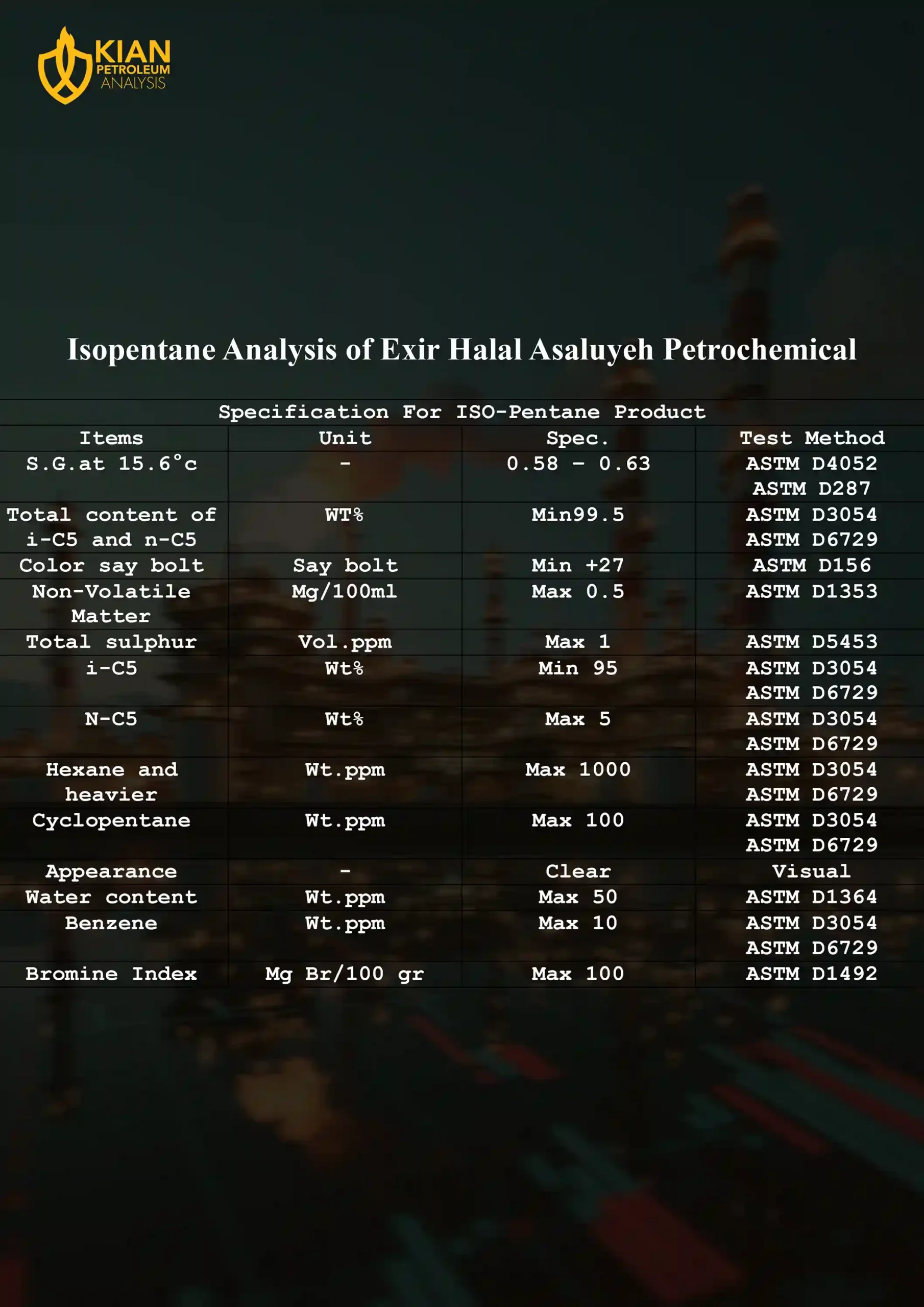
According to the isopentane analysis from Exir Halal Assaluyeh Petrochemical, isopentane constitutes at least 95% of the product’s weight, while normal pentane accounts for a maximum of 5%. This indicates high purity and quality, making this composition ideal for sensitive industrial applications such as solvent production, chemical manufacturing, and polymer industries.
S.G at 15.6°C
The SG (Specific Gravity) parameter represents the ratio of liquid isopentane’s density to the density of pure water at 15.6°C. This ratio determines whether isopentane is heavier or lighter than water. According to the analysis report, the SG value for isopentane is less than 1, meaning that isopentane is lighter than water and floats on its surface.
Being lighter than water is a key physical property of isopentane, which can be beneficial in some cases and challenging in others. This characteristic is advantageous in the petrochemical industry for easier separation, reduced groundwater contamination, and enhanced volatility. However, it also increases flammability risks and necessitates safer storage systems. Therefore, proper management of this substance in industrial processes is crucial.
Impurities
Cyclopentane, hexane, and heavier compounds are among the impurities present in normal pentane, and their concentration must be carefully controlled to maintain product quality. Cyclopentane can alter properties such as boiling point, vapor pressure, and viscosity, potentially causing issues in precise industrial applications like polymer production and solvent manufacturing. Additionally, an increase in hexane and heavier compounds can lead to reduced volatility, deposit formation, and thermal instability, which may negatively impact fuel octane rating adjustments and the production of plastics and polymers. According to the petrochemical analysis, the concentration of these impurities must not exceed 1000 ppm to ensure the product’s high quality and performance.
Saybolt Color Scale
The Saybolt Color Scale is a recognized and standardized method for assessing the clarity and color of refined liquids. This scale ranges from -16 to +30, where higher values indicate greater purity and better transparency. According to quality standards, a minimum value of +27 signifies that the product possesses high transparency, is nearly colorless, and is free from impurities caused by oxidation or other contaminants.
Non-Volatile Matter
Non-volatile matter refers to compounds that do not evaporate under normal industrial processing temperatures and must be carefully controlled. Excessive amounts of these substances can lead to deposit formation in equipment, reduced process efficiency, and lower product quality. These impurities typically originate from residuals in refining processes, environmental contaminants, or incomplete separation of heavier fractions during distillation. According to the analysis report, the maximum allowable limit for this parameter is 0.5%, indicating high product quality and an efficient refining process.